Wednesday, April 3, 2013

Thinking Outside of the Box....or Outside of the Proscenium!

Hello once again Shakespeare Students,

This week we are going to be talking about staging.  One thing that is really cool about theater is that it is meant to be visual! Plays are not simply to read, they are meant to be performed.  Shakespeare plays have been performed in countless different mediums and styles.  They  have been put into different time periods.  For example, I once attended a performance of The Taming of the Shrew that was set in the 80's.  The typical format of one stage with the audience in front and full Shakespearean garb is not always what is chosen.  In fact, even the way the audience is seated can vary from play to play.  Here are the main types of staging that are used: 

Proscenium: This is the most typical type of staging.  It is also what you have probably seen before.  It looks like this: 
theatredesigner.wordpress.com
The audience is seated in front of a stage that constitutes the playing space. 


Thrust: This type of staging brings the playing space forward into the audience.  This allows the audience to surround the action, which can create a more interesting audience/player dynamic.  It looks like this:
https://encrypted-tbn2.gstatic.com/images?q=tbn:ANd9GcSz4MXzJHBMjvRpnDkD5DboIHfD6g4xCOGkVm16jvTTEBlU3No

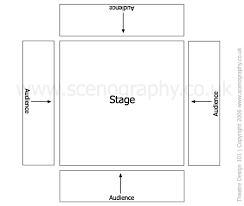
Alley: Alley is a more extreme form of thrust.  It takes the stage and puts the audience on either side.  This can be a complicated form of staging to allow everyone to see, but it has its uses.  It looks like this: 
www.masterarts.org

In the Round: In the round allows for a playing space in the middle with audience members all around.  This allows for a more involved audience experience and can allow for interaction between the audience and the players.  This can take many forms, but it may look something like either of these: 
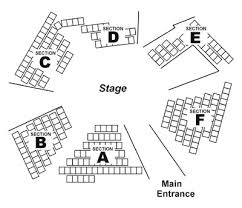


theatreintheround.org                                                                                          theatredesigner.wordpress.com


So, what I would like you to do is to take one style of staging and a time period to set one of Shakespeare's plays in.  Give a brief description of what the staging would look like and how you would reflect your time period in your version of the play and why you made this decision.  This should be about a paragraph long.  Please comment on another person's post as well.  

Good luck and have fun,
Ms. Kindel

Monday, April 1, 2013

An Interesting Question

Hello again Shakespeare Students,

Our question for today will challenge much of what we have talked about with Macbeth.  Now, so far we have talked a lot about Macbeth's fatal flaw: ambition.  His ambition drives him to kill King Duncan to take the throne.  And we have talked also about how the idea of destiny plays into this.

But my question to you, is if this is a flaw contained only within Macbeth or within all humans?  Imagine for a moment that the witches come up to Macduff, not Macbeth with a prophesy about becoming the king.  Macduff and Macbeth have very similar situations: both are noblemen and well-respected in the military.  Both begin the play dutiful to their king.  Both have wives that they wish to support.

Do you think that Macduff would have acted in the same way that Macbeth did?  What I would like you to consider is: What does it take to convince someone to kill?  Is there a price that we all have? At the end, could it have been Macbeth holding Macduff's traitorous head?

Answer this question in a comment.  You should write a paragraph (5-7 sentences) with a well-reasoned argument.  Comment on two other student's comments following the protocol listed in the first post.  Remember to keep all comments appropriate.

Have fun as you contemplate the true nature of man.

Ms. Kindel

Saturday, March 23, 2013

Poll: The Play's the Thing

Hello Shakespeare Students!

It is time to get started with our course.  However, to do so, we need to make a choice on our first piece of reading material.  We are going to start our first play.  Shakespeare wrote several different genres of plays.

Comedies

Histories

And...

Tragedies

So, it is up to you to decide which type of play you would like to start with.  But here's the catch.  You need to discover for yourself what these genre's mean.  So, look it up and then comment with your preferred beginning genre as well as a 2-3 sentence definition of what that genre is.  Genre definitions must be in your own words, so do not copy any one else's definition.  For this poll, your comments on other's work will be very short.  Simply pick another person's definition and comment with a Shakespeare play that falls under that category.

Have Fun!

Ms. Kindel

Thursday, January 17, 2013

Online Etiquette

Hello again Shakespeare Students,

Before we begin posting and commenting on our blog, I wanted to take some time to go through some important guidelines for online safety.  I am willing to bet that all of you have been on a website where there is a section for comments.  If you have ever read the comments, say, on a Youtube video, you have probably noticed some incredibly harsh things.  The anonymous nature of the internet can cause people to say things that they never would in person.  They are rude and often profane to people that they disagree with.  We are not creating this blog as a tool to hide behind.

We are using this blog with the express purpose of creating an online learning community.  And in that community we want everyone to feel as though they are safe in sharing their opinion.  With that in mind there are a few guidelines that I expect you to take into account when we are posting or commenting.


  1. There is to be no profane language in your posts.  All posts are expected to be school appropriate.  Yes at some points Shakespeare does swear in his text, which may bring up challenges when paraphrasing.  I am confident that you can use your creativity to come up with a school appropriate substitute.  
  2. Argument is great!  Argument is a great starter for a really intelligent conversation, if it is done right.  If you disagree with someone, feel free to say so.  However, you must be ready to back up your point with at least two sentences explaining your reasoning.  And no, insulting the person who wrote the post does not count as proper reasoning, regardless of what you might read in a lot of internet comments.
  3. Any inappropriate comments will be removed from the blog and you will not receive credit for that post.  First offense you will have one chance to repost and after that you simply will not receive credit.
  4. If there is any question about whether your post is appropriate you may always email me what you are planning on posting and I will let you know.
  5. In general, however, don't say anything you wouldn't say to another's face, or anything that you would not want said to yours.
I believe that this can be a great experience for this class.  I hope that everyone will take advantage of it.  

Ms. Kindel


Welcome to our Blog

Hi Shakespeare Students,

Welcome to the blog component of our class.  There are two main things that we will use this blog for.

1. I will post weekly discussion/writing prompts on this blog.  These prompts will have to do with our reading for the week.  I may have you analyze a quote, give your opinions on a character or to put a section of text into your own words.  Your job will be to reply to this post as a comment.  I will also ask you to comment on another student's post.

     Guidelines:

  • Posts should be 1-2 paragraphs in length, comments should be 3-4 sentences in length
  • Posts should attempt to be meaningful and provide for discussion.
  • Make sure to answer all questions in the prompt as there may be multiple points.
  • Comments and Posts should be appropriate (I will post more on this in a separate post about online safety before we start)
  • Prompts will be posted on Mondays and you will have until Wednesday to reply
  • When commenting you must say more than a simple "good job."  Ask a question, add to a statement, go further.  If you do want to say what you like/disliked be sure that you explain why.
2. We will then use the discussions on the blog to help further our class discussions.  

I hope you guys are looking forward to the blogging experience.  I think it will be a great way to add collaboration to our discussion of meaning and themes.

Ms. Kindel